From your late thirties, testosterone drifts down by a small percentage each year. Here is what actually changes, which signs are worth noting, and the honest split between what lifestyle and what a supplement can do.
What happens after 40
Testosterone typically peaks in early adulthood and then declines gradually — on the order of roughly 1% a year from the late thirties onward for many men. This is a normal part of ageing, not a disease in itself. Because it is slow, most men feel it as a vague, cumulative change rather than a sudden drop.
That slowness is exactly why it is so easily misattributed. A man in his fifties who feels flatter than he did at thirty rarely wakes up one morning to a dramatic change; he notices, over years, that things he took for granted take a little more effort. Because the shift is gradual and multi-causal, blaming hormones alone is usually too simple — but so is ignoring the role they play.
The everyday signs
The common, non-alarming signs include lower daytime energy, reduced drive, slower recovery after exertion, shifts in mood or focus, and changes in body composition. None of these is proof of anything on its own — they overlap heavily with poor sleep, stress and other conditions — which is exactly why guessing is a bad idea.
This overlap is the trap. Low energy and low drive can come from a hormone shift, but they can just as easily come from a bad month of sleep, a stressful stretch at work, an under-active thyroid, low iron, depression, or simply doing too little exercise. A supplement aimed at hormones will do nothing for a problem that was never hormonal. That is why the honest next step, when the signs persist, is testing rather than assuming.
When to see a doctor
If the signs are persistent or affecting your life, the right move is a doctor and a blood test, not self-diagnosis and not a supplement. Clinically low testosterone is a medical matter with medical options. A dietary supplement does not diagnose or treat it, and no honest product will claim otherwise.
A blood test also gives you a baseline to act from rather than a guess to worry about. If your levels are normal, you can stop attributing every tired afternoon to hormones and look at sleep, stress and activity instead. If they are genuinely low, that is a conversation about medical options with someone qualified to have it — a far better position than quietly hoping an over-the-counter capsule will do a doctor's job.
What lifestyle does
The unglamorous levers do the heavy lifting: consistent sleep, resistance training and regular movement, a protein-forward diet, managing stress, limiting alcohol, and keeping body weight in a healthy range. These have the best-supported influence on maintaining healthy testosterone as you age — more than any capsule.
Where a supplement fits
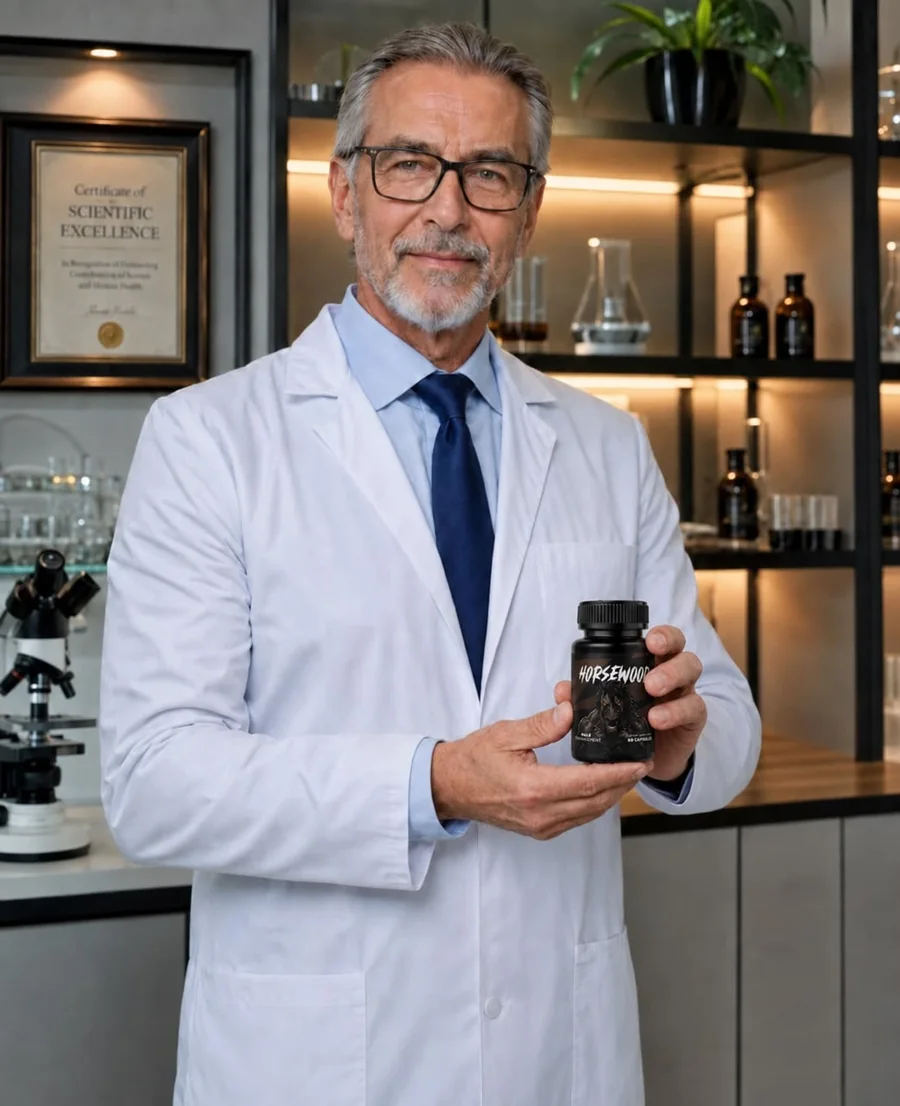
Within that lifestyle foundation, some men add a botanical supplement for daily support. Ingredients like Tongkat Ali and Boron are studied for supporting testosterone already within a normal range — supporting, not raising into abnormal territory, and not treating a deficiency. That is the honest role Horsewood is built to play: a supporting part, layered on top of the basics, never a replacement for them.
Myths worth clearing up
Two myths cause the most confusion. The first is that declining testosterone is a disease every man must fight — for most, it is a normal, gradual part of ageing, and only a doctor can say whether yours is clinically low. The second is that a supplement can "boost" testosterone to youthful levels; honest botanicals support what is already within a normal range, they do not override your physiology or treat a deficiency. Any product promising to restore your twenty-five-year-old hormone profile is selling a story.
A sensible plan by decade
In your forties, the highest-value moves are foundational: protect sleep, add resistance training, keep alcohol modest, and get a baseline blood test if symptoms nag. In your fifties and beyond, the same foundations matter more, not less, and recovery becomes the thing to protect — more rest between hard efforts, more attention to protein and movement. A daily supplement like Horsewood sits on top of that as optional supporting layer, never as the plan itself. The men who do best treat the capsule as the smallest part of the strategy, not the whole of it.
The honest takeaway
Testosterone decline after 40 is normal, gradual and manageable — not a crisis, and not something a single product fixes. Get the foundations right, see a doctor if the signs are persistent or severe, and treat any supplement as a supporting layer with realistic structure-and-function expectations. Botanicals such as Tongkat Ali and Boron are studied for supporting testosterone already within a normal range — a genuine but modest role. Kept in that perspective, a daily formula can be a sensible part of ageing well: never the whole answer, but not nothing either.
Before you start any supplement
Speak with your physician first if you take blood pressure medication, blood thinners or anticoagulants, hormone therapy or any hormone-related medication, if you manage a serious medical condition, or if you have any history of a hormone-sensitive cancer. Not for anyone under 18, and not for women. Nothing here is medical advice. These statements have not been evaluated by the Food and Drug Administration, and this product is not intended to diagnose, treat, cure or prevent any disease.